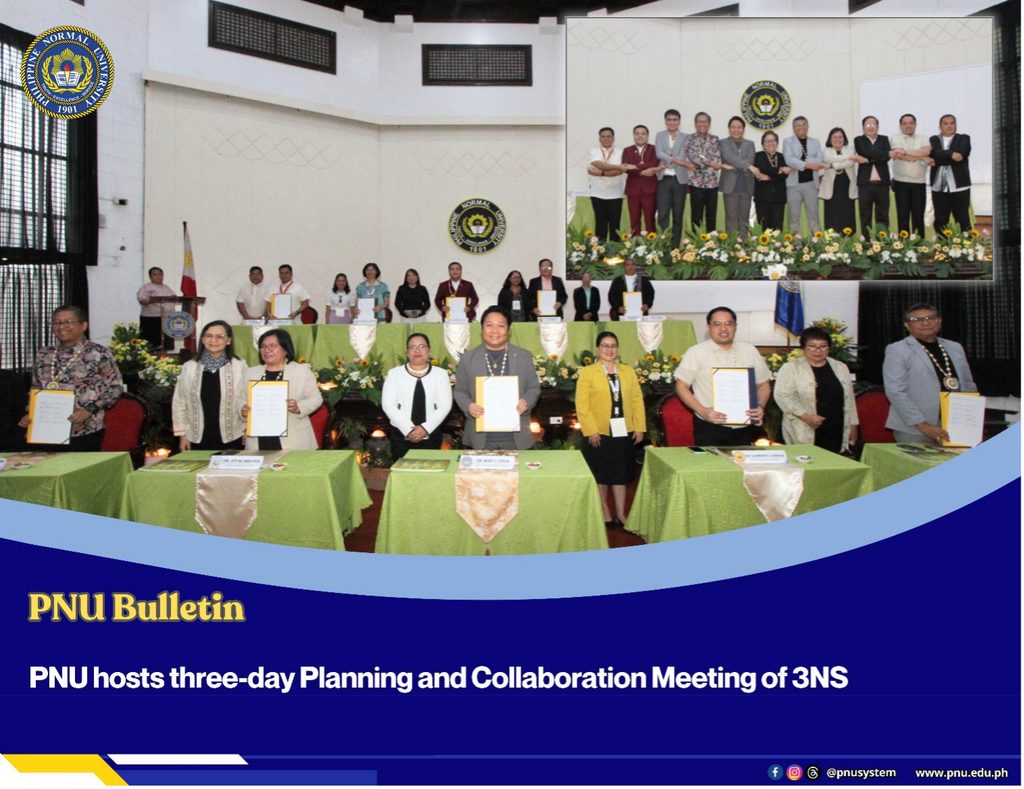
The Philippine Normal University (PNU) convened the members of the National Network of Normal Schools (3NS) for its Three-Day Planning and Collaboration Meeting from October 14 to 16, 2026, at its main campus in Manila. The event brought together key educators, leaders, and representatives from ten member universities: Bicol University (BU), led by President Dr. Baby Boy Benjamin D. Nebres III; Bukidnon State University (BukSU), led by President Dr. Joy M. Mirasol; Cebu Normal University (CNU), led by President Dr. Laurence L. Garcia; Leyte Normal University (LNU), led by President Dr. Gil Nicetas B. Villarino; Mariano Marcos State University (MMSU), with President Dr. Virgilio Julius P. Manzano represented by Vice President for Academic Affairs Dr. Aris Reynold V. Cajigal; Palawan State University (PalSU), led by President Dr. Venzon L. Limpiada; Pangasinan State University (PangSU), led by President Dr. Elbert M. Galas; the host institution, Philippine Normal University, led by President Dr. Bert J. Tuga; West Visayas State University (WVSU), led by President Dr. Joselito F. Villaruz; and Western Mindanao State University (WMSU), with President Dr. Ma. Carla B. Ochotorena represented by Dr. Ricardo Somblingo, Dean of the College of Teacher Education.
A central highlight of the opening day was the presentation of the revitalized 3NS Governance and Organizational Framework, led by PNU Vice President (VP) for Academics, Dr. Marilyn U. Balagtas. The 3NS institutional representatives later discussed establishing an Executive Steering Council—composed of the university presidents—to make the governance structure more robust. In addition, VP Balagtas proposed housing the 3NS Secretariat permanently at PNU and establishing a 10-year Memorandum of Understanding (MOU) renewal cycle anchored on the 2026–2035 strategic roadmap. Following the plenary, 3NS delegates participated in two days of hybrid parallel breakout sessions. Vice Presidents from the member institutions led discussions to evaluate mandates and emerging priorities across nine standing committees: (1) Literacy and Numeracy Programs, facilitated by VP Marissa S. Pontillas of PalSU; (2) Research and Publication, facilitated by VP Teresita T. Rungduin of PNU; (3) Curriculum and Academic Collaboration, facilitated by VP Aris Reynold V. Cajigal of MMSU; (4) Internationalization and Mobility, facilitated by VP Hazel Jean M. Abejuela of BukSU; (5) Conference and Events, facilitated by VP Lordinio A. Vergara of PNU; (6) Professional Development and Training, facilitated by VP Ma. Asuncion Christine V. Dequilla of WVSU; (7) Partnerships, MOA/MOU, and Network Coordination, facilitated by VP Leah Amor S. Cortez of PNU; (8) 3NS Performance Evaluation, facilitated by VP Ma. Julieta Borres of BU; and (9) Digital Transformation and Knowledge Management, whose focal persons are yet to be identified.
On Day 2, the 3NS planning session featured lectures by Prof. Bryan C. Dayuta, Director of PNU’s Linkages and Internationalization Office; Dr. Ma. Arsenia C. Gomez, Director of PNU’s Research Management Office; and Dr. Ester B. Ogena, 3NS Founding President and former PNU President. The sessions focused on reconnecting with the network’s historic roots as standard-setting institutions and transitioning from basic cooperation to deep strategic collaboration.
A pivotal highlight of the event was the formal signing of the Memorandum of Understanding. The 3NS university presidents sealed their shared ideals through statements of commitment to shape the future of Philippine teacher education. PNU President Dr. Bert J. Tuga articulated the network’s call to elevate its collective mission, ensuring that inter-institutional collaboration translates into transformative reforms for teacher education across the country.
To translate this shared vision into concrete action, the network’s standing committees outlined comprehensive strategic roadmaps during parallel planning workshops, covering priorities from the literacy agenda and collaborative research frameworks to strategic management and professional development initiatives. The day concluded with a cultural night and fellowship, fostering personal connections and a unified resolve among delegates from all ten member institutions.
The event concluded on Day 3 with a unified roadmap outlining upcoming milestones, action items, and partner responsibilities for the remainder of the academic year. VP Balagtas presented the initial 3NS Ecosystem Blueprint, which envisions a unified ecosystem for the network from 2026–2035. Dr. Cortez, PNU VP for Student Success and Stakeholder Services, identified specific institutional assignments to bridge collaboration gaps, pairing lead 3NS institutions with supporting partner universities under a timeline of priority periods. VP Balagtas also reiterated immediate next steps for the coming 12 months, starting with the identification and onboarding of focal persons for all standing committees and a review of assignments to ensure clear delineation and prevent overlaps. In his closing message, PNU VP for Finance and Administration Dr. Vergara expressed gratitude for the commitment affirmed throughout the workshop. He emphasized that translating these agreements into concrete action is even more vital than the words spoken during the event. As the host institution, PNU reaffirmed its dedication to facilitating continuous collaboration among normal schools across the nation to drive meaningful impact in the Philippine education sector.