
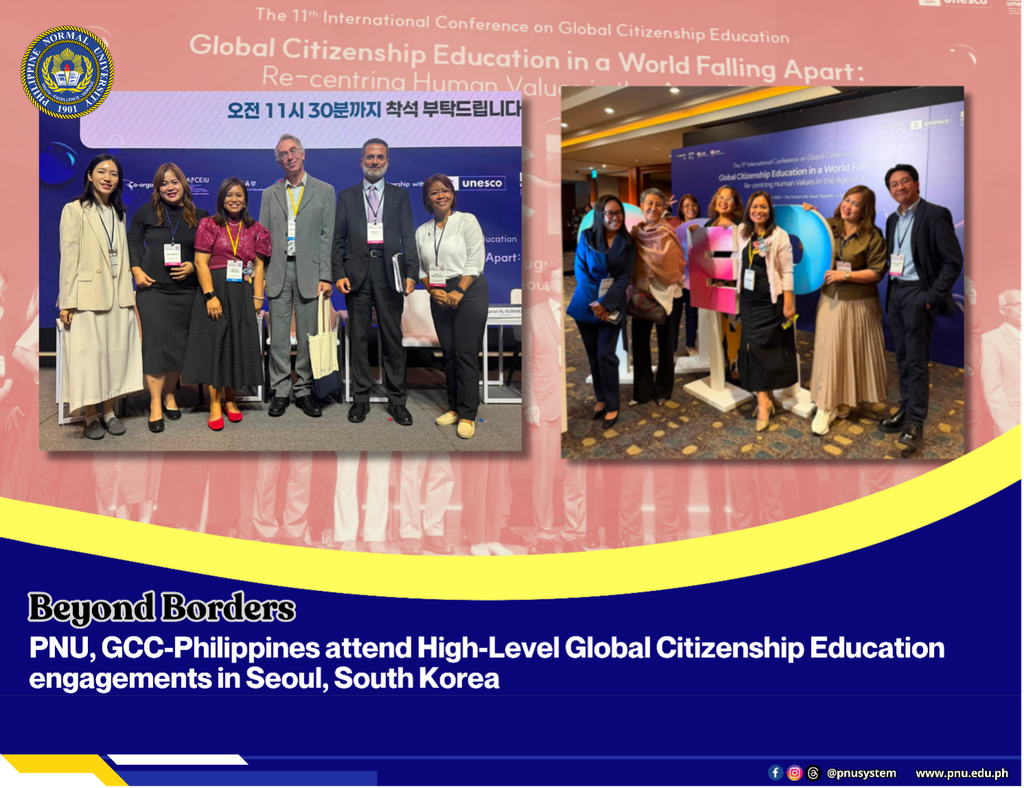
Philippine Normal University (PNU), through the GCED Cooperation Centre–Philippines (GCC-Philippines), reinforced its commitment to Global Citizenship Education (GCED) by participating in a series of high-level regional and international engagements in Seoul, Republic of Korea, from August 25 to 27, 2026. Organized by the Asia-Pacific Centre of Education for International Understanding (APCEIU) under the auspices of UNESCO, these events brought together global educational leaders, experts, and practitioners to address pressing challenges, exchange best practices, and chart future directions for GCED. The GCC-Philippines delegation was led by Dr. Rowena R. Hibanada, Director, alongside Dr. Zyralie L. Bedural, Project Leader.
The engagements commenced on August 25, 2026, with the GCC Consultation Meeting 2026, organized as part of APCEIU’s continuing efforts to strengthen the capacity of partner institutions and promote GCED across the region. The consultation gathered APCEIU coordinators, resource persons, and delegates from partner institutions across Malaysia, the Philippines, Indonesia, Bangladesh, and Nepal. Serving as a key platform to evaluate progress, address challenges, and review insights from the 2026 implementation of the GCC Programme, the meeting also focused on formulating strategic plans for 2027 while fostering networking and future cooperation among participating institutions. As Director of GCC-Philippines at PNU, Dr. Hibanada participated in both the joint session and individual consultations specifically allotted for the Philippines. Her involvement highlighted the importance of responding to diverse social and educational contexts, sharing insights from the Philippine perspective, and exploring strengthened collaborative opportunities to mainstream GCED within national education systems.
Following the consultation, Dr. Hibanada represented the university at the 11th International Conference on Global Citizenship Education (IConGCED), held from August 26 to 27, 2026, at the Lotte Hotel Seoul. Carrying the theme “Global Citizenship Education in a World Falling Apart: Re-centring Human Values in the Age of AI,” the conference convened over 300 participants, including educators, youth, GCED experts, practitioners, policymakers, civil society groups, private-sector representatives, and international and regional organizations. The conference provided a venue for dialogue on the evolving role of GCED amidst rapid technological, social, and global shifts, exploring the intersections of artificial intelligence, geopolitical conflicts, ecological crises, and social fragmentation. Discussions emphasized the need to re-center human values in education while developing learners’ critical thinking, empathy, solidarity, respect for diversity, and collective agency through transformative pedagogies and innovative practices aimed at deepening collective commitment toward peaceful, just, and sustainable societies.
During the conference, Dr. Hibanada actively contributed as both a session moderator and a research presenter, bringing the Philippine context to international discussions. She served as moderator for Concurrent Session 1B, titled “Teaching at the Edge: Restoring Human Relationality in Times of Crisis,” where she facilitated exchanges among global speakers and participants on critical issues related to GCED and the roles of teachers. In addition, Dr. Hibanada presented a research paper co-authored with Prof. Carl O. Dellomos entitled “Reimagining Global Citizenship Education: A Youth-Driven Policy Agenda for the Philippines,” which spotlighted youth participation and youth-driven perspectives in shaping national policy directions for GCED.
In parallel with the conference engagements, Dr. Zyralie L. Bedural participated in the 11th Global Capacity-Building Workshop on GCED, an international learning and professional development initiative focused on enhancing participants’ knowledge, skills, and practices in global citizenship education. Through active involvement in capacity-building activities and professional exchanges with fellow GCED practitioners, Dr. Bedural gained valuable insights to advance GCED initiatives within the Philippine education context, complementing the broader international representation of PNU and GCC-Philippines in Seoul.
The participation of Dr. Hibanada and Dr. Bedural across these international gatherings reaffirmed PNU’s and GCC-Philippines’ dedicated leadership in advancing global educational dialogue and professional capacity-building. By facilitating critical discussions on teaching during crises, presenting youth-driven policy research, and engaging in strategic regional planning, the delegation elevated the global visibility of both PNU and GCC-Philippines while reaffirming the Centre’s commitment to advancing and mainstreaming Global Citizenship Education across the country.