
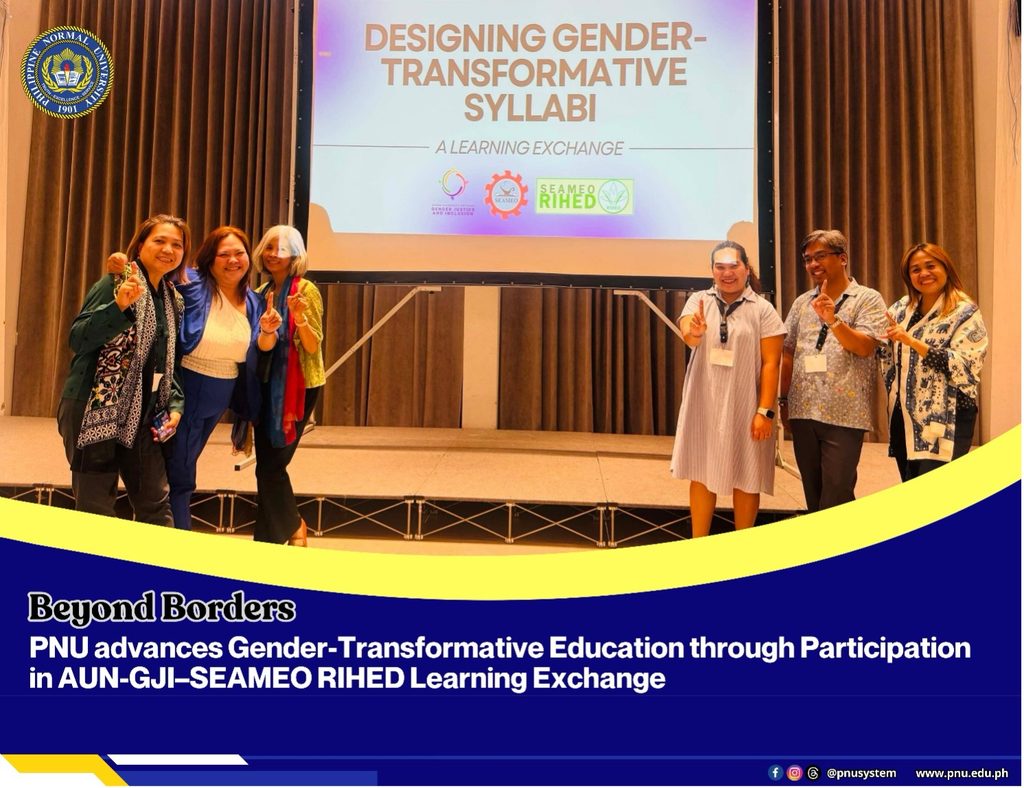
Representatives of the Philippine Normal University (PNU) participated in the Learning Exchange Program on Designing Gender-Transformative Syllabi, held from August 31 to September 2, 2026, at Chulalongkorn University in Bangkok, Thailand.
Organized by the ASEAN University Network on Gender Justice and Inclusion (AUN-GJI) in partnership with the Southeast Asian Ministers of Education Organization Regional Centre for Higher Education and Development (SEAMEO RIHED), the three-day program gathered educators, curriculum developers, researchers, and academic leaders from the Philippines, India, Thailand, and Timor-Leste.
Participation in the learning exchange was determined through a competitive selection process, with applicants evaluated based on their institutional roles, relevant experience, proposed initiatives, and potential contributions to gender-transformative education. The selection of six PNU representatives affirmed the University’s growing leadership and commitment to advancing gender justice and inclusion in teacher education.
As a member institution of the ASEAN University Network (AUN), PNU continues to actively participate in regional initiatives that promote academic cooperation, inclusive education, and institutional transformation across Southeast Asia.
The learning exchange built on the Forum on Gender-Transformative Curriculum: Reimagining Education and Advancing Gender Justice in ASEAN, held in December 2025 at the University of the Philippines Diliman. It aimed to translate earlier regional discussions into practical strategies for curriculum development, inclusive teaching, transformative assessment, and institutional implementation.
PNU was represented by Prof. Iona Ofelia B. Zanoria, Director of the Gender Equity, Diversity, and Inclusion Office; Dr. Zyralie L. Bedural of the Faculty of Behavioral and Social Sciences; Dr. Jayson L. De Vera of the Faculty of Science, Technology, and Mathematics; and the heads of the Gender Equity, Diversity, and Inclusion Units from the University’s campuses: Dr. Raquel R. Geronimo of PNU North Luzon, Prof. Brenda O. Bua-ay of PNU South Luzon, and Dr. Lallen B. Quismundo of PNU Mindanao. Their participation strengthened the University’s continuing commitment to gender equity, diversity, inclusion, and transformative teacher education.
During the first day, participants mapped persistent gender justice issues affecting higher education. Among the concerns identified were the absence of clear institutional policies, limited integration of gender-related learning outcomes, gender stereotypes in instructional materials, discrimination against LGBTQ+ learners, sexual harassment, gender-based violence, patriarchal norms, and inadequate faculty training.
The discussions emphasized that merely adding gender-related content to a syllabus does not automatically make it gender-transformative. Genuine transformation requires educators and institutions to critically examine whose knowledge and experiences are represented, whose voices are heard, who participates in learning, and who may remain excluded.
The second day focused on designing gender-transformative pedagogy and assessment. Participants explored the integration of explicit GEDI frameworks across disciplines, including science, technology, artificial intelligence, agriculture, and climate change. They also examined inclusive design thinking, participatory classroom dialogue, stakeholder mapping, empathy-based activities, reflective assessments, and equity-oriented capstone projects.
The participants collaboratively developed a gender-transformative syllabus anchored on four key elements: explicit GEDI frameworks, inclusive design thinking, dialogue-driven pedagogy, and equity-oriented assessment. These approaches seek to help learners understand power, representation, access, vulnerability, and inequality alongside disciplinary knowledge.
On the final day, participants translated their insights into institutional action plans. They identified three priorities: strengthening policy, governance, monitoring, and evaluation; implementing relevant programs, activities, and projects; and providing sustained training and capacity building for educators.
The proposed Philippine action plan includes conducting educator orientations, facilitating syllabus-writing and updating workshops, reviewing existing syllabi, and piloting gender-transformative approaches during Academic Year 2026–2027. Participants also recommended strengthening regional collaboration through faculty exchanges, joint research, shared instructional resources, syllabus peer reviews, and formal institutional partnerships.
For PNU, the learning exchange provides valuable direction for curriculum review, faculty development, inclusive assessment, policy formulation, and the continuing implementation of its GEDI-Responsive Curriculum Framework.
As the country’s National Center for Teacher Education, PNU plays a vital role in preparing educators who can foster safe, equitable, and inclusive learning environments. The knowledge and partnerships developed through the program are expected to support the University’s efforts to move beyond compliance and toward genuine institutional transformation.
The Bangkok learning exchange underscored that gender-transformative education involves more than revising the content of a syllabus. It calls for changes in how educators teach, how students participate, how learning is assessed, and how institutions address structures and practices that perpetuate inequality. Through its participation, PNU reaffirmed its commitment to advancing an education that promotes equity, inclusion, dignity, meaningful participation, and social transformation across the ASEAN region.