

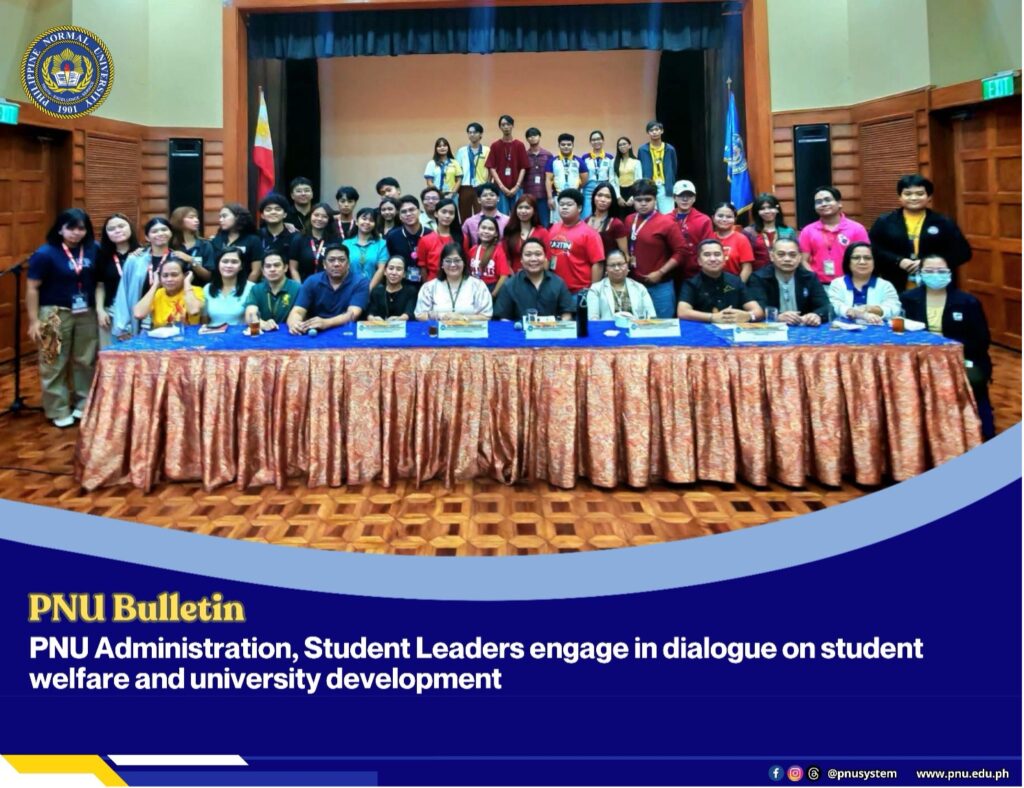
Demonstrating the University’s commitment to open communication, participatory governance, and student-centered decision-making, Philippine Normal University administrators and student leaders engaged in a six-hour dialogue on June 17, 2026. The meeting provided a meaningful platform to discuss concerns, clarify policies, and identify collaborative solutions for the continued development of the University community.
Leading the administration’s delegation was University President Dr. Bert J. Tuga. He was joined by Vice President for Academics Dr. Marilyn U. Balagtas; Vice President for Finance and Administration Dr. Lordinio A. Vergara; Vice President for Research, Extension, and Quality Assurance Dr. Teresita T. Rungduin; and Vice President for Student Success and Stakeholders’ Services Dr. Leah Amor S. Cortez.
Other officials present were Dr. Merimee T. Siena, Student Affairs and Services Director; Prof. John P. Natividad of the Facilities Management and Sustainability Office; Prof. Romeo Rioflorido, Center for Culture and Sports Development Director; Mr. Harry Huliganga, Finance Management Office Director; Ms. Argea Linn Palabrica, Accounting Unit Head; Ms. Florence Allejos, Budget Unit Head; Prof. Ma. Laarni D. Buenaventura, Student Development Services Unit Head; and Mr. Leonardo Prudencio, Coordinator for Student Activities.
Representing the student sector were Torch Publications Editor-in-Chief Ruzzel Anne Dela Peña and University Student Council-Central Student Council Chairperson Jhenine Sioson. They were accompanied by other student leaders who brought forward concerns and recommendations from various sectors of the student body.
The student representatives presented a comprehensive six-point agenda. Their priorities included the expansion of student spaces, the enhancement of health services, and the establishment of inclusive support mechanisms such as gender-neutral uniforms and comfort rooms. Additionally, the agenda called for increased budget allocations, alongside improved salaries and subsidies for student assistants, performers, and student-athletes. Finally, the students advocated for the strengthening of free and accessible education and sought clarification on key University policies, particularly concerning the proposed National University for Teacher Education (NUTE) Bill and issues related to red-tagging.
The students meticulously prepared their concerns and inquiries, which were grounded in sustained engagement and consistent dialogue with the broader student body to ensure the issues raised genuinely reflected the needs and sentiments of the community.
Throughout the meeting, student leaders were given the opportunity to present their perspectives and explain the impact of these issues on the student community. University officials listened to the concerns raised and responded by providing explanations, updates, and clarifications on existing policies, ongoing initiatives, and administrative processes.
Discussions on student spaces centered on the growing demand for accessible and conducive areas where students can study, conduct organizational activities, and convene for academic and extracurricular purposes. Student representatives emphasized that the spaces currently allocated for student organizations in the Old ITL Building and the Old Finance Building are limited and not conducive to effectively supporting operations. They likewise raised concerns regarding the offices of the Student Electoral Commission and the Student Tribunal, which continue to be shared by both entities, constraining their capacity to work independently. In response, University administrators acknowledged these concerns and discussed ongoing efforts to optimize existing facilities while exploring long-term solutions.
Student leaders also actively advocated for greater institutional support for student-led programs by raising concerns regarding the allocation of funds for the University Student Council. In response, university officials provided an overview of the existing budgetary framework. At present, the University Student Council manages a budget of approximately Php 1.5 million, while Torch Publications has an allocation of approximately Php 3.1 million.
Recognizing the students’ desire to expand programs and services, the administration discussed available mechanisms to help student leaders maximize existing resources. This exchange reflected the students’ commitment to strengthening campus engagement and securing additional support for their peers. The administration, in turn, reaffirmed its commitment to supporting student development while ensuring that financial decisions remain aligned with institutional priorities, accountability measures, and available resources.
Funding concerns for student-athletes were likewise discussed. Student representatives highlighted the importance of sustained support for athletes who represent the university in various competitions. Administrators recognized the value of student-athletes in promoting the university’s excellence and assured participants that efforts are being made to address concerns related to training, participation, and financial assistance.
Initiatives to institutionalize gender-neutral uniforms were raised as part of the University’s commitment to inclusivity, equity, and the promotion of an affirming environment for all students. The proposal received the support and concurrence of the University administrators. In addition, student representatives raised the recently approved Magna Carta for Undergraduate Students, underscoring the need for its formal recognition. Administrators advised that the measure be further elevated and endorsed to the Board of Regents to facilitate its official adoption within the University.
The proposed NUTE Bill was another key agenda item. Student leaders sought clarification regarding the university’s position on the measure and its potential implications for PNU and the broader teacher education sector. University officials provided updates on related developments and shared their perspectives on how the legislation could affect the institution.
Concerns regarding red-tagging were also raised, with student representatives expressing the need to protect academic freedom, freedom of expression, and the welfare of students. Administrators acknowledged the sensitivity of the issue and reiterated the university’s commitment to maintaining a safe academic environment where students can participate in discussions without fear of harassment or discrimination.
President Tuga assured student leaders that the administration remains committed to addressing concerns raised by the student body and finding solutions through continuous dialogue. He emphasized that while some issues may require long-term planning, the administration remains open to engaging with students and considering their perspectives in university decision-making.
The meeting spanned approximately six hours, demonstrating not only the administration’s commitment to addressing student concerns but also the dedication of the student leaders who constructively participated. The extensive dialogue provided a meaningful platform to thoroughly examine complex institutional issues, exchange perspectives, and identify actionable steps toward addressing shared concerns. The students’ passion for advocacy and their call for collaborative solutions underscored the importance of continued partnership between the administration and the student body.
University officials and student leaders alike expressed hope that the dialogue would serve as a foundation for continued engagement. Moving forward, the student representatives remain steadfast and committed to advancing initiatives that promote the welfare, rights, and holistic development of the student body, continuously striving for the betterment of the University community.