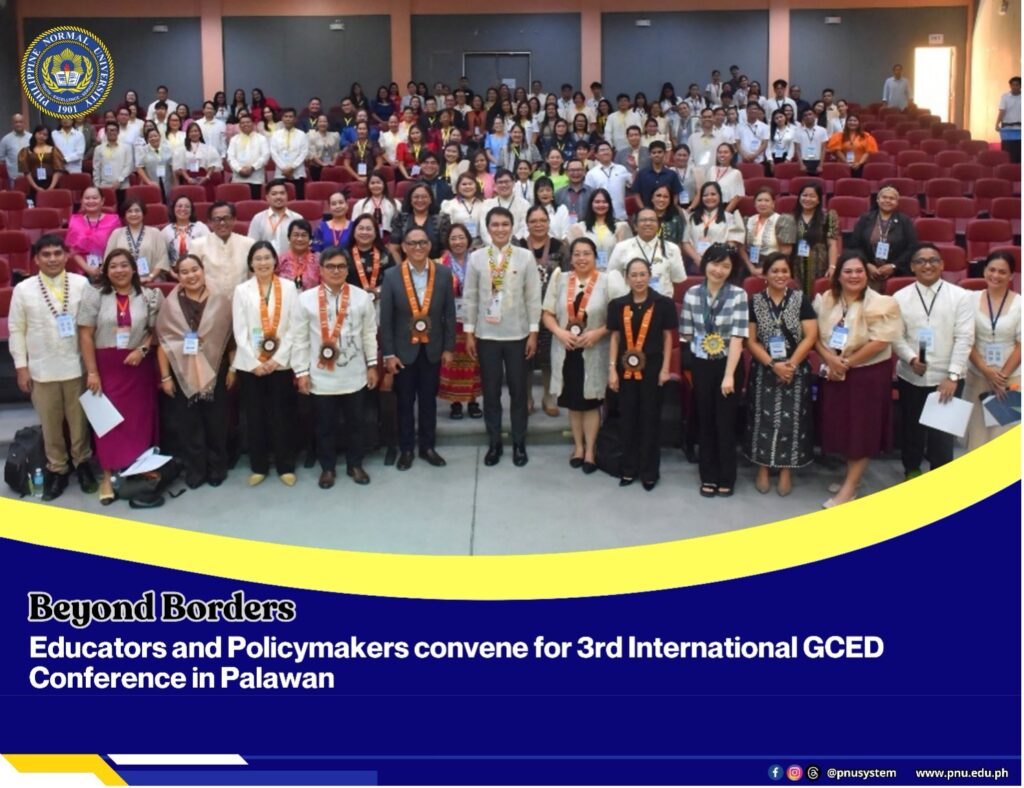
More than a hundred educators, researchers, policymakers, students, and Global Citizenship Education (GCED) advocates gathered at Palawan State University for the 3rd GCC International Research Conference on Global Citizenship Education, reaffirming the vital role of higher education institutions as catalysts for peace, sustainability, and transformative global citizenship.
Organized by the GCED Cooperation Centre–Philippines (GCC Philippines) of the Philippine Normal University, in partnership with Palawan State University and the Asia-Pacific Centre of Education for International Understanding (APCEIU), under the auspices of UNESCO and the UNESCO National Commission, this year’s conference was anchored on the theme, “Academe as a Global Actor for Peace and Global Citizenship Education: Transformative Pathways for International Understanding through Education for Sustainable Development and Global Citizenship Education.”
The three-day international gathering provided a platform for meaningful dialogue, research exchange, policy discussions, and collaborative action on advancing Global Citizenship Education (GCED) and Education for Sustainable Development (ESD).
The conference formally opened with messages from institutional and international partners, highlighting the collective commitment to mainstreaming GCED in higher education. Palawan State University President Dr. Venzon L. Limpiada, Philippine Normal University President Dr. Bert J. Tuga, represented by Vice President Dr. Leah Amor S. Cortez, GCC Philippines Director Dr. Rowena R. Hibanada, UNESCO National Commission of the Philippines Deputy Executive Director Lindsay A. Barrientos, and APCEIU Head of External Relations and Information Yangsook Lee underscored the importance of strengthening partnerships that empower educational institutions to respond to pressing global challenges. GCC Philippines Deputy Director Prof. Carl O. Dellomos likewise presented the conference’s statement of purpose, emphasizing the need to translate research into transformative educational practice. A ceremonial Memorandum of Agreement signing between the Philippine Normal University, GCC Philippines, and Palawan State University further reinforced the institutions’ shared commitment to advancing Global Citizenship Education nationwide.
Setting the tone for the conference, Dr. Min Joung Park of the Korea National Diplomatic Academy delivered the keynote address on “ASEAN Community Vision 2045 and the Role of Global Citizenship Education: Building Regional Resilience in a Fragmented World,” highlighting the importance of regional cooperation, intercultural understanding, and education in building resilient ASEAN communities. This was followed by the first plenary session led by Dr. Christopher M. Magno of Gannon University, USA, who discussed Data Democracy and the role of ethical and participatory data systems in promoting justice, democratic participation, and global citizenship.
The first afternoon featured three concurrent policy workshops focusing on embedding GCED across learning systems, advancing peace education, and promoting lifelong learning pathways. Participants engaged in collaborative discussions that generated recommendations aimed at strengthening institutional practices and informing future policy directions.
Day Two highlighted the growing intersection of policy, teacher education, youth engagement, and regional collaboration. Ms. Lindsay A. Barrientos opened the day’s plenary with a discussion on Learning Cities as pathways toward peace, sustainability, and Global Citizenship Education, followed by Ms. Jihong Lee, Founder of ConnectED Lab, Republic of Korea, who shared Korea’s experiences in preparing teachers for Global Citizenship Education. Representing the voice of Filipino youth, Mary Anvil L. Pineda of Palawan State University inspired participants through her presentation on youth leadership, democracy, and civic engagement in shaping sustainable futures.
One of the conference highlights was the panel discussion entitled “From Vision to Action: Strengthening Regional Hubs for Transformative Global Citizenship Education in the Philippines,” moderated by Dr. Rowena R. Hibanada. Representatives from GCC Regional Hubs shared best practices, innovations, and regional experiences in implementing GCED initiatives, demonstrating how higher education institutions across the country continue to localize Global Citizenship Education while responding to their respective regional contexts. The dialogue emphasized the importance of sustained collaboration, institutional commitment, and shared leadership in expanding the impact of GCED nationwide.
The afternoon sessions continued with workshops on monitoring and evaluation frameworks for GCED implementation and integrating the West Philippine Sea into Global Citizenship, peace, and sustainability education. These discussions further strengthened participants’ understanding of evidence-based implementation and context-responsive educational approaches.
On the third day, the conference showcased the research contributions of educators and scholars through four parallel paper presentation sessions covering Curriculum, Pedagogy and Teacher Development; Language, Literature and Intercultural Learning; Peace, Values and Civic Engagement; and Institutional Resilience and Sustainable Development in Higher Education. A total of 21 research papers were presented, reflecting diverse perspectives and innovative practices that contribute to the advancement of Global Citizenship Education and Education for Sustainable Development across Philippine higher education institutions.
The conference concluded with the presentation of policy briefs developed from the five Policy Lab workshops, each synthesized and presented by their respective facilitators. Dr. Cristeta C. Dulos presented the policy brief on mainstreaming GCED in curricula; Dr. Ludivina B. Dekit, on strengthening peace education; Dr. Janet A. Mananay, on integrating lifelong learning; Dr. Jovar G. Pantao, Director of the Center for Instructional Development at Mindanao State University–General Santos, on developing monitoring and evaluation frameworks; and Dr. Lhynette T. Zambales, on contextualizing the West Philippine Sea within Global Citizenship Education. Developed under GCC Philippines with Deputy Director Prof. Carl O. Dellomos, these policy recommendations represent the conference’s commitment to producing actionable outcomes that can inform institutional policies and educational reforms.
Closing remarks and the presentation of ways forward reaffirmed the participants’ shared vision of strengthening collaboration and advancing transformative education across the country.
Extending learning beyond the conference halls, participants also joined the “GCED in Action” Community Immersion, where they engaged with Palawan State University’s community extension initiatives. The activity highlighted the practical application of Global Citizenship Education through community engagement, local partnerships, and sustainable development initiatives, reinforcing the conference’s message that education becomes most meaningful when translated into action.
As the 3rd GCC International Research Conference on Global Citizenship Education concluded, participants left Palawan with strengthened partnerships, renewed commitments, and concrete strategies to advance Global Citizenship Education within their respective institutions and communities. More than an academic gathering, IRCON GCED 2026 demonstrated how collaboration among higher education institutions, government agencies, international organizations, and regional partners can collectively shape a more peaceful, inclusive, and sustainable future through education.