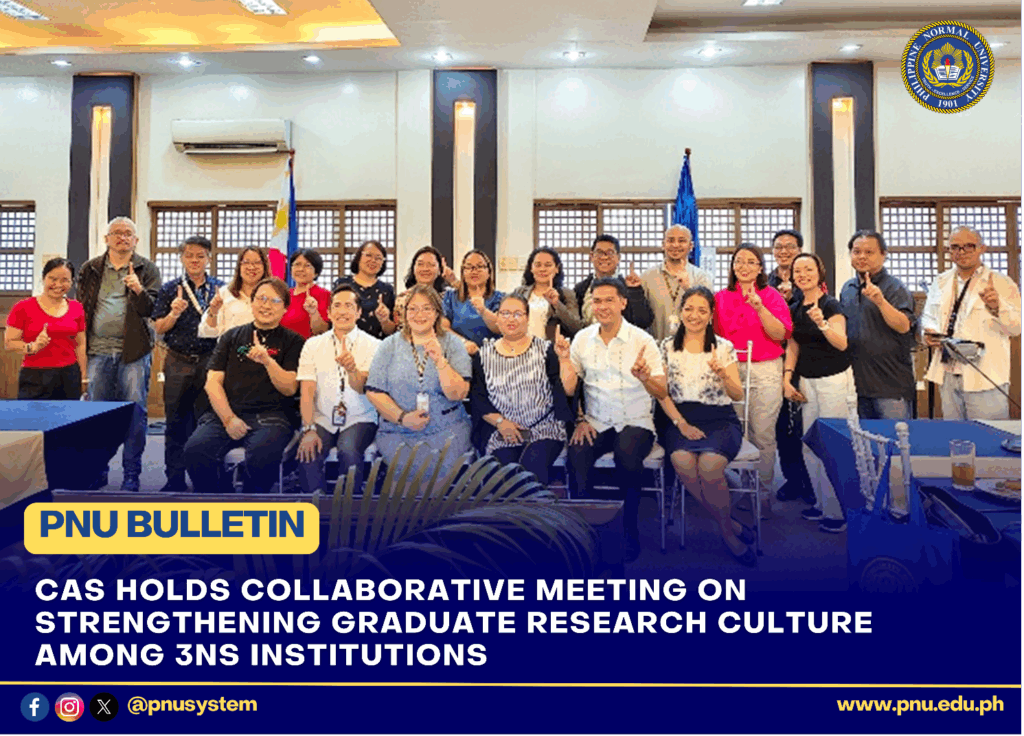
In a significant move toward advancing the research culture among Teacher Education Institutions (TEIs) in the Philippines, the College of Advanced Studies (CAS) at the Philippine Normal University (PNU) successfully organized a three-day collaborative meeting for the National Network of Normal Schools (3NS) on April 23–25, 2025. The event, themed “Graduate Research Culture in 3NS: A Conversation for Future Collaborations,” convened deans, researchers, faculty members, and international experts to develop a structured research framework aligned with national educational priorities and global research standards.
The National Network of Normal Schools (3NS) was established to promote collaboration and innovation among Philippine Normal Schools, particularly in teacher education. Over the years, the need to cultivate a strong research culture has become increasingly urgent, recognizing that research is the intellectual lifeblood of universities, supports quality teaching, and underpins community extension initiatives. According to the proposal leading to the event, strengthening graduate research culture will serve not only institutional goals but also national development priorities, particularly the Sustainable Development Goal 4 (SDG 4) on Quality Education. It further emphasized the strategic importance of full participation from 3NS partners, PNU academic administrators, deans, faculty members, and staff to ensure the gathering’s success.
The program offered a balanced mix of lectures, dialogues, workshops, and strategic planning over the three-day meeting. On the first day, activities focused on establishing the foundations of research culture. The opening ceremonies welcomed representatives from Mariano Marcos State University, Pangasinan State University, Bicol University, Palawan State University, Leyte Normal University, Cebu Normal University, and Bukidnon State University. PNU Vice President for Academics Dr. Marilyn U. Balagtas delivered the welcome remarks, while Vice President for Student Success and Stakeholders Services (4S), Denmark L. Yonson, conveyed the message of PNU President Dr. Bert J. Tuga. Dean Antriman V. Orleans of CAS outlined the rationale behind the workshop, emphasizing the pivotal role of research in advancing teacher education. Visiting professors Dr. Adrian Rodgers and Dr. Mekasha Kassaye Gobaw shared international perspectives on building sustainable research cultures, underscoring key pillars such as governance, mentoring, collaboration, and research-informed teaching.
The second day deepened collaboration among 3NS partners. A keynote address by Dr. Ester B. Ogena, immediate past President of PNU, highlighted the importance of enhancing research culture through institutional collaboration. Two workshops were conducted, with participants engaging in breakout sessions focused on theorizing the development of research culture, identifying support components for research excellence, examining the governance of research programs, exploring the nexus between research and teaching, and formulating a collective research agenda. Discussions also explored opportunities with funding agencies and international programs such as Erasmus Mundus, laying out a roadmap for sustainable collaboration and innovation.
On the final day, participants presented the outputs of their breakout sessions, sharing strategic plans and collaborative projects aimed at strengthening research cultures across the 3NS member institutions. Dr. Levi P. Elipane, Deputy Dean of CAS, synthesized the workshop’s key insights, while Dr. Teresita T. Rungduin, PNU Vice President for Research, Extension, and Quality Assurance, delivered the closing remarks, expressing gratitude to all participants for their commitment and active engagement.
The collaborative meeting achieved several significant outcomes, including the development of initial frameworks to strengthen research cultures across 3NS member institutions, strategic planning for future research collaborations and funding pursuits, enhanced awareness of research governance and mentoring structures, and a strengthened commitment among normal schools to pursue excellence in graduate teacher education research. The event also laid the groundwork for future collaborative projects aimed at addressing national education challenges and promoting the Philippines’ position in the global academic community.
Overall, the 3NS Collaborative Meeting demonstrated that Philippine normal
schools, through collective action, strategic dialogue, and a shared commitment to research excellence, can forge a future-ready, research-driven graduate education landscape. By nurturing a vibrant culture of inquiry and innovation, 3NS stands poised to make significant contributions to national development and educational leadership, reaffirming its vital role in the future of Philippine teacher education.