
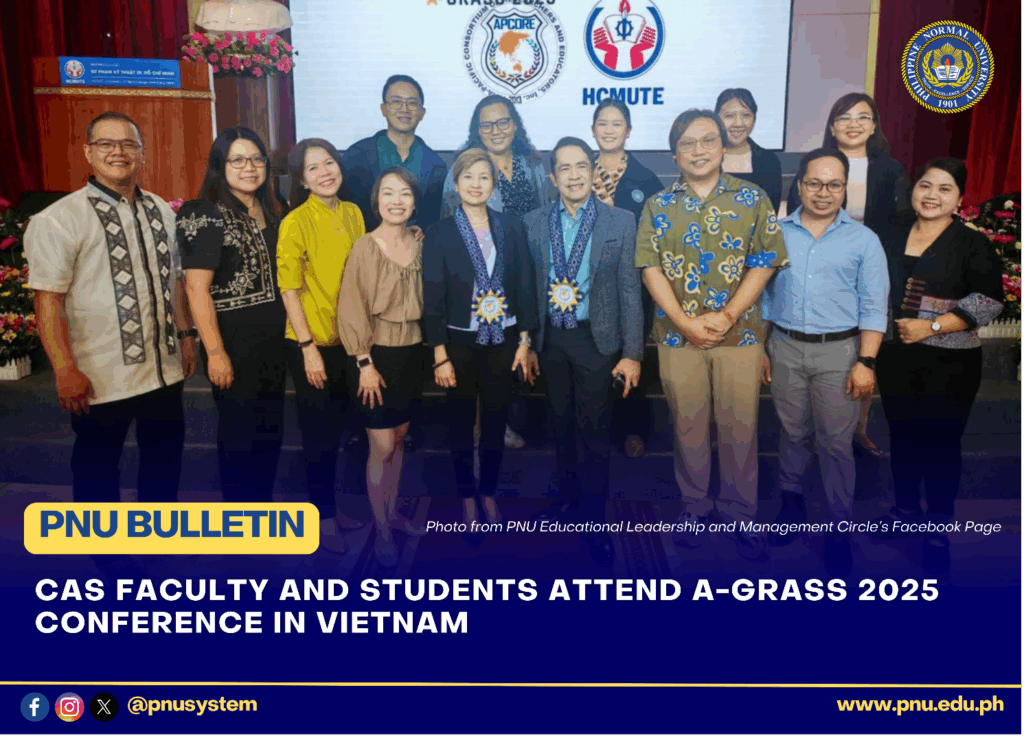
The College of Advanced Studies (CAS) at the Philippine Normal University (PNU) recently made a significant impact at the Asian Graduate Studies Summit (A-GRASS), an event organized by the Asia Pacific Consortium of Researchers and Educators (APCORE). The summit, hosted by the Ho Chi Minh University of Technology and Education, Ho Chi Minh City, Vietnam, brought together a distinguished multidisciplinary forum of graduate students, educators, and researchers from across Asia on May 21-24, 2025.
Under the compelling theme “Bridging Knowledge to Action: Transformative Graduate Education and Research for Sustainable Asia,” the summit brought together leading minds. The CAS was well-represented onsite, with Dean Dr. Antriman V. Orleans and Deputy Dean Dr. Levi E. Elipane at the forefront. They were joined by faculty members Dr. Gilbert S. Arrieta, Dr. Joyce L. Bautista, Dr. Allen A. Espinosa, Dr. Heidi B. Macahilig, Dr. Arlyne C. Marasigan, Dr. Maria Azela L. Tamayo, Dr. Leonora P. Varela, and Prof. Brenda O. Bua-ay, all of whom actively contributed to the diverse program. Adding to the participation were graduate students Charlene Lyn L. Chua, Christine Andrea O. De Lara, Diana S. Andres, Archie R. Arranguez, and Lj Malaya B. Libunao.
The opening ceremonies set a clear agenda with an inspirational keynote address delivered by Dr. Tram Nam Tu. He reaffirmed the vital role of translating academic insights into tangible, real-world solutions. Dr. Tu outlined a compelling roadmap for achieving this, emphasizing the urgent need to strengthen industry-academia-government networks, boost investment in technology transfer, build robust research capacities, and strategically align academic priorities with pressing national and global development goals.
Following this visionary address, the first Roundtable Discussion delved into “Pedagogical Innovations and Sustainable Research in Graduate Education: Perils, Pitfalls, and Pearls.” Dr. Marie Paz E. Morales, Director of the Publication Office, PNU; Dr. Kolpheng Vaddahana, Undersecretary of State, Kingdom of Cambodia; Dr. Edgar G. Cue, University President, Mountain Province State University, Philippines; Dr. Thi Kim Oanh Duong, Vice Dean of the Institute of Education, Ho Chi Minh University of Technology and Education, Vietnam; and Dr. Jennifer D. Tucpi, Vice President of Academic Affairs, Lyceum of the Philippines University, provided a rich discussion on the challenges and successes in modernizing graduate education.
The afternoon signaled a commitment to tangible partnerships with a Networking Lunch and Partnership Signing. Demonstrating a strong dedication to international collaboration, the summit facilitated significant agreements poised to open new avenues for academic exchange and joint research initiatives. Notably, Dr. Antriman V. Orleans, representing the PNU, joined 29 other partner institutions from diverse Asian countries, including Brunei, China, Russia, Malaysia, Cambodia, Thailand, Indonesia, and host country Vietnam. This collective effort solidifies a shared vision for a more interconnected and impactful academic landscape.
The day then shifted focus to practical skill-building with the Research Bootcamp. This intensive session offered attendees a choice of engaging breakout sessions, including “Community Impact: Universities’ Foremost Responsibility,” “Research Proposal Development for Sustainable Solutions,” “Generative AI from the Point of View of Gen X Researcher and Mentor,” “Data Analytics and AI for Graduate Research,” and “Humanities Reimagined: Digital Tools for Innovative Research and Storytelling.” These diverse topics equipped participants with cutting-edge knowledge and tools to enhance their research endeavors. Day one concluded with a Welcome Dinner, providing a relaxed setting for delegates to connect, share insights, and forge new relationships, setting a collaborative tone for the days ahead.
The momentum of the summit continued into its second day, which began with a brief recapitulation of the previous day’s key takeaways, setting the stage for discussions. The morning’s highlight was a keynote address by Prof. Dr. Qi Xinjian, Assistant Director of the UNESCO International Research and Training Center for Rural Education in Beijing, China. His address, “Bridging Knowledge to Action: Sustainable Research for Asia’s Emerging Global Role,” provided a critical perspective on how research can drive sustainable development as Asia’s influence on the world stage continues to grow.
Following the insightful keynote, the second Plenary Roundtable Discussion captivated attendees with its theme: “Future Scenarios in Graduate Education in the Asia-Pacific: Bleak or Bright.” This session ignited a lively discussion among experts, prompting participants to consider the myriad factors—from policy reforms and global partnerships to technological advancements—that will shape the trajectory of graduate education in the region. The conversation highlighted both the formidable challenges and the immense opportunities that lie ahead, leaving delegates with much to ponder.
A productive networking lunch then provided another opportunity for delegates to connect and exchange ideas. The afternoon was dedicated to paper presentations. Researchers from various institutions presented their completed works across a broad spectrum of disciplines, including business, finance and management, education, engineering and technology, natural sciences, social sciences, and arts and humanities. Notably, faculty members and graduate students from Philippine Normal University (PNU) proudly showcased their research, contributing to the rich tapestry of knowledge shared at the summit.
The third and final day of the summit shifted focus to the crucial practical applications of academic work and the celebration of research excellence. The morning began with Plenary Session 1, where Dr. Songheang Ai, Center Director of SEAMEO TED, Cambodia, presented on “Strengthening University-Industry Linkages for Research and Innovation.” His insights underscored the vital synergy between academia and industry, highlighting how robust partnerships can accelerate both knowledge creation and societal impact.
This was followed by Session 2, “From Global Metrics to Local Mission: The Role of SDGs and THE Rankings in University Development.” Dr. Witawat Jangiam delivered a presentation, emphasizing how global benchmarks like the Times Higher Education (THE) Impact Rankings and the United Nations Sustainable Development Goals (SDGs) can serve as powerful compasses for universities in shaping their local missions and fostering meaningful development. The discussions underscored the strategic importance of aligning institutional goals with broader global objectives.
The morning concluded with Session 3, featuring Dr. Ly Thien Trang, Vice President of HUTECH University of Technology, Vietnam, who spoke on “The Role of Universities in Driving Regional Sustainability and Development.” Her address reinforced the indispensable role of higher education institutions as catalysts for progress and sustainability within their respective regions.
Following a final networking lunch, delegates were invited to participate in a Campus Tour, offering a glimpse into the host institution’s facilities and academic environment.
The summit culminated in a highlight moment: the awarding of the 2025 A-GRASS Best Research Papers. This prestigious recognition celebrated outstanding contributions to various fields. Among the distinguished finalists from Philippine Normal University (PNU) were faculty researchers Dr. Leonora P. Valera, Dr. Heidi B. Macahilig, and Dr. Allen A. Espinosa, whose work garnered well-deserved attention. A moment of particular pride for the PNU was the recognition of Prof. Brenda O. Bua-ay of PNU South Luzon being awarded the Best Research Paper in SDG 4: Quality Education for her study titled “Teaching Science in Indigenous Communities: An Activity Systems Perspective,” a testament to her impactful contributions to sustainable development through
education. The award ceremony brought a fitting close to a productive and inspiring three-day summit.
The College of Advanced Studies remains committed to actively engaging in international forums that promote academic excellence, interdisciplinary collaboration, and the transformative power of graduate education and research for a sustainable future.