

For years, discussions on Philippine education reform have focused on curriculum, learning materials, assessment results, and school resources. Less frequently discussed is the institution responsible for preparing the teachers who stand at the center of the education system.
A proposal now gaining support in the Senate and the House of Representatives seeks to address this gap by expanding the mandate of the Philippine Normal University (PNU), the country’s National Center for Teacher Education.
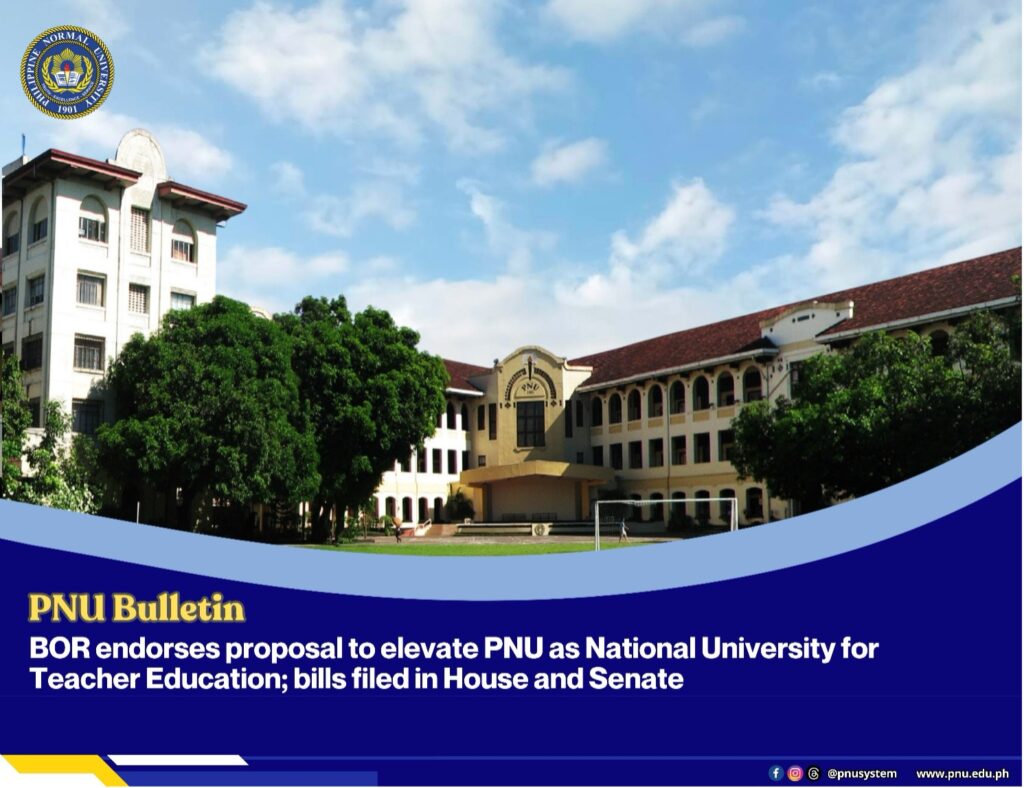
The Board of Regents of PNU, by virtue of Resolution No. U-4055, s. 2026, has endorsed the proposed Revised Philippine Normal University Charter, a measure that seeks to designate the University as the National University for Teacher Education (NUTE).
If enacted, the proposal would expand PNU’s role in teacher preparation, educational research, policy development, professional learning, and technical assistance to institutions and agencies involved in teacher education.
The proposal arrives at a time when education reforms remain a national concern as conveyed by EDCOM II. International assessments have repeatedly highlighted learning gaps among Filipino learners, while policymakers, educators, and researchers continue to examine the factors that shape educational quality. Central to these discussions is the preparation, development, and support of teachers throughout their professional careers. In this context, University officials and education stakeholders argue that the evolving demands of teacher education call for a stronger institutional framework—one capable of driving research, innovation, policy development, and professional learning on a national scale.
The proposed revision in the charter would strengthen PNU’s research institutes, revitalize laboratory schools to support clinical teacher preparation, expand continuing professional development programs for teachers and school leaders, democratize access to the PNU teacher education programs, strengthen faculty, personnel, and student support, modernize facilities and infrastructure, and institutionalize support mechanisms and collaborations with teacher education institutions and agencies involved in education governance. This includes the Department of Education (DepEd), Commission on Higher Education (CHED), Teacher Education Council (TEC), Professional Regulation Commission (PRC), Technical Education and Skills Development Authority (TESDA), and the Department of Economy, Planning and Development (DEPDev).
The proposal is the product of consultations, technical reviews, and legislative discussions conducted over several months. A University Technical Working Group composed of faculty members, students, administrators, legal experts, and education specialists led the drafting process. Consultations were undertaken with government agencies, teacher education institutions, state universities and colleges, professional organizations, students, faculty members, staff, alumni, and other stakeholders in the education sector.
The measure has since moved into the legislative arena. In the Senate, Senator Sherwin “Win” Gatchalian filed Senate Bill No. 2125, which seeks to revise the PNU Charter and formally designate the University as the National University for Teacher Education. In the House of Representatives, House Bill No. 9403 was filed by Akbayan Representatives Percival V. Cendaña, Jose Manuel Tadeo “Chel” Diokno, and Dadah Kiram Ismula, together with Dinagat Islands Representative Kaka Bag-ao. A separate counterpart measure, House Bill No. 9399, was likewise filed by Leyte Representative Ferdinand Martin G. Romualdez and Tingog Party-list Representatives Yedda Marie K. Romualdez and Jude A. Acidre, proposing the revision of the PNU Charter and the declaration of PNU as the National University for Teacher Education. Acidre is the Chair of the House Committee on Higher and Technical Education and sits as a member of the PNU Governing Board.
The proposal has also undergone legislative reviews and consultations with the offices of several lawmakers, including Representative Nicolas “Niko” Daza of the 1st Congressional District of Northern Samar, whose office provided recommendations on the draft charter and is expected to file the bill in Congress. Taken together, the reviews generally recognized the measure as comprehensive, forward-looking, and responsive to the need for sustained reforms in teacher education. They likewise highlighted the importance of strengthening institutions responsible for teacher preparation, research, professional learning, and policy development as part of broader efforts to improve educational outcomes nationwide.
The proposal has likewise received the endorsements of the member institutions of the Association of Southeast Asian Teacher Education Network (AsTEN), the National Network of Normal Schools (3NS), the Philippine Association of State Universities and Colleges – National Capital Region (PASUC-NCR), and the South Manila Education Consortium (SMEC), among other stakeholders in the teacher education sector.
This legislative initiative comes at an opportune time. This year, PNU marks 125 years since its establishment as the Philippine Normal School in 1901, and 15 years as the National Center for Teacher Education by virtue of RA 9647. PNU, as the oldest public teacher training institution in the country, has sustained itself as a “normal” university with more than 90% of its academic programs dedicated to teacher education, while maintaining a few specializations in allied fields. Recently, the University was recognized as the country’s most consistent top performer in the teacher licensure examinations and was identified as the leading National Center of Excellence in Teacher Education, including its campuses, by the Teacher Education Council.
PNU President Dr. Bert J. Tuga said the proposal is intended to strengthen the institution’s capacity in developing the country’s teaching workforce.
“The proposed NUTE Charter recognizes that improving educational outcomes begins with strengthening the institutions responsible for preparing teachers. Through this measure, PNU seeks to contribute more effectively to research, policy development, professional learning, and innovation in teacher education to fully support the country’s education agenda.”
The proposed charter will continue to undergo committee deliberations and legislative review in both chambers of Congress.
While awaiting updates on the bill’s movement in the upper and lower houses of Congress, the PNU administration continues to facilitate discussions on how to shape the legislation to benefit more stakeholders. On June 17, 2026, during a dialogue between university officials led by Dr. Tuga and various student organizations, student representatives expressed their concerns regarding different facets of the bill. In the spirit of transparency, Dr. Tuga addressed these apprehensions by clarifying the bill’s salient features. The University President concluded with an assurance that the student body will be heavily involved in drafting the Implementing Rules and Regulations (IRR), especially on matters directly affecting them. Furthermore, Dr. Tuga requested that lines of communication between the administration and students remain open for consultations on any possible amendments.
The University seeks the support of its stakeholders for the passage of the proposed NUTE Charter. Stakeholders who wish to obtain copies of the latest draft of the proposed charter, submit comments and recommendations, or seek clarification on its provisions may contact the NUTE Technical Working Group through the Office of the Vice President for Research, Extension, and Quality Assurance at vpreqa@pnu.edu.ph.