
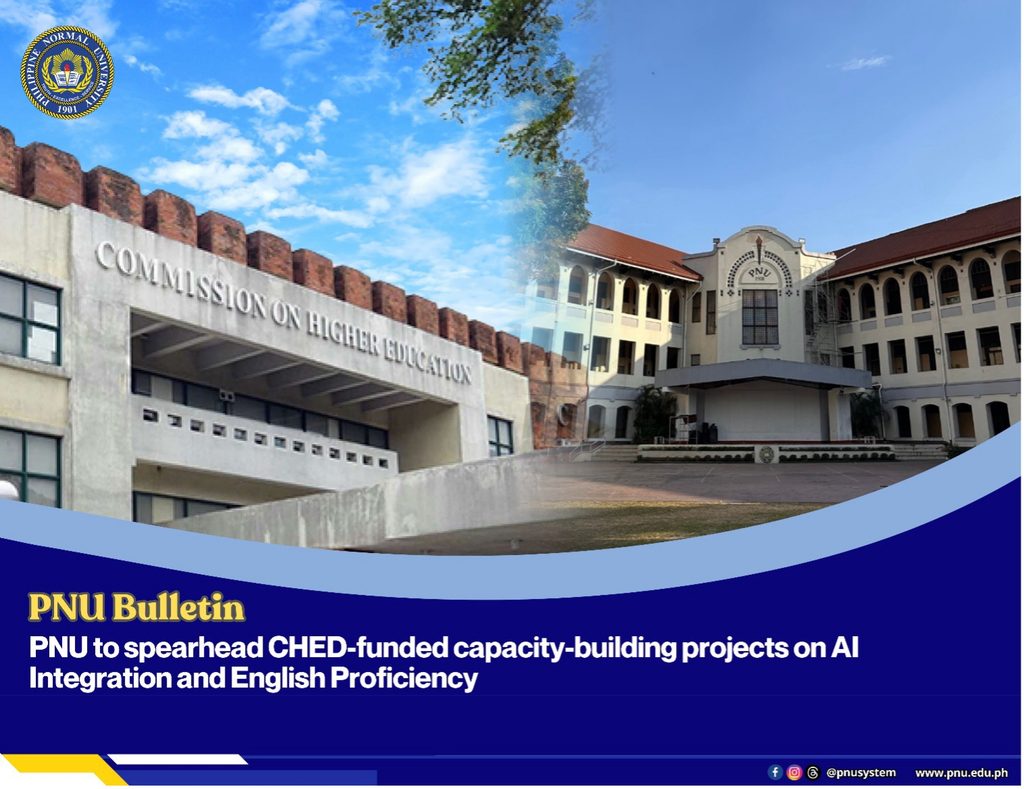
The Philippine Normal University (PNU), the country’s National Center for Teacher Education, is set to roll out two major capacity-building initiatives funded by the Commission on Higher Education (CHED) aimed at equipping teacher education faculty nationwide with competencies in artificial intelligence (AI) integration and English as a Medium of Instruction (EMI). Through the CATALYST Program and SPEAK Project Phase I, PNU seeks to modernize pedagogical practices and address critical classroom gaps across Teacher Education Institutions (TEIs) from the undergraduate to graduate levels.
Proposed for support under CHED’s Higher Education Upskilling and Study for Advancement of Staff and Faculty (HUSAY) Program, the CATALYST (Critical and Applied Training on AI-Assisted Learning and AI-Supported Teaching) Program is a five-day faculty development initiative delivered through flexible modalities. The program will cater to faculty members and academic leaders across the country, including participants from PNU, the program provider, as well as representatives from National and Regional Centers of Excellence in Teacher Education, previous CHED-designated Centers of Excellence, and member institutions of the National Network of Normal Schools (3NS).
Drawing on PNU’s expertise, CATALYST emphasizes experiential learning, discipline-based collaboration, guided practice, and critical reflection so educators can integrate generative AI into teaching, learning, assessment, and research while preserving academic integrity and student-centered learning. Over the five-day curriculum, participants will progress from examining the current AI landscape and its capabilities, limitations, and risks on the first day to establishing learning-centered and responsible AI boundary frameworks on the second day. The third day focuses on guided practice in AI-supported academic work, followed by the collaborative design of discipline-based, inter-institutional micro-credentialing programs on the fourth day. The training culminates on the fifth day with presentations, peer learning, and institutional commitments that will inform broader policy development.
Alongside technological upskilling, PNU is tackling the national decline in communicative proficiency through SPEAK Project, a PhP 50-million nationwide commissioned research and intervention initiative aligned with CHED’s A.C.H.I.E.V.E. Strategic Agenda. The said project will be implemented in partnership with the British Council, the National Network of Normal Schools (3NS), and Centers of Excellence in Teacher Education. The project targets a critical bottleneck in the pedagogical chain: teacher education faculty, particularly those in technical and professional disciplines who struggle to convey complex concepts in English, which often leads to student disengagement. Because these educators train future basic education teachers, strengthening their proficiency is treated as a non-negotiable prerequisite for arresting the broader national literacy decline.
Recognizing the unique opportunities and socioeconomic challenges of the Philippines’ multilingual landscape, SPEAK Phase I moves away from one-off workshops in favor of sustained, collaborative, and evidence-based professional development. The framework integrates content and language through CLIL/4C-style curriculum making, addresses faculty needs in English for Academic Purposes (EAP), prepares educators to navigate policy-practice tensions, and legitimizes strategic translanguaging—respecting the Filipino language as a complementary pedagogical resource rather than a replacement.
Phase I of the SPEAK Project focuses on project inception and national benchmarking, beginning with the creation of the PNU Core Group (PCG) to serve as the National Project Secretariat and Research Lead team responsible for project management and terms of reference. The Core Group will then consult with language education experts and specialists from leading local universities to gather insights and weave best EMI practices into the program’s action plan and research directions. Finally, to establish unified, national-level baseline data on English proficiency, PNU will coordinate with the British Council for the nationwide administration of the Aptis diagnostic test, issuing a call for participation to all TEIs—including State Universities and Colleges (SUCs), Local Universities and Colleges (LUCs), and private Higher Education Institutions (HEIs)—to nominate their teacher education faculty.
Together, the CATALYST and SPEAK initiatives position PNU and CHED at the forefront of systemic educational reform, ensuring public funds are maximized to equip the country’s teacher educators for both the demands of globalized communication and the rapidly evolving digital landscape.
Aside from the CATALYST and SPEAK initiatives in the pipeline, PNU is already actively implementing two other major CHED-funded undertakings that advance regional leadership and national sustainability in higher education. The first is the Capacity Building of Higher Education Institution Centers of Excellence for the Establishment of the ASEAN Center for Teacher Education and Development (ACTED), which serves as the preparatory phase for a proposed ASEAN-recognized regional center to be hosted by the Philippines through PNU. This initiative encompasses technical preparation, benchmarking, stakeholder consultations, capacity building, legal and governance groundwork, and strategic planning to ensure institutional readiness for ASEAN endorsement and long-term sustainability. Concurrently, the university has also spearheaded the National Higher Education Institutions’ Sustainable Development Goals (SDG) Project Management Team Meeting, a three-day technical working convergence uniting the SDG Monitoring and Reporting Framework (SDGMRF) national project team, Regional Data Managers, systems developers, statisticians, data visualizers, and partner HEI representatives. Through this collaborative meeting, the team reviewed implementation progress, resolved operational and data challenges, harmonized validation and indicator procedures, and finalized the strategic work plan ahead of the upcoming HEI SDG Dashboard and Roadmap launch. This endeavor was delivered in partnership with Mariano Marcos State University.