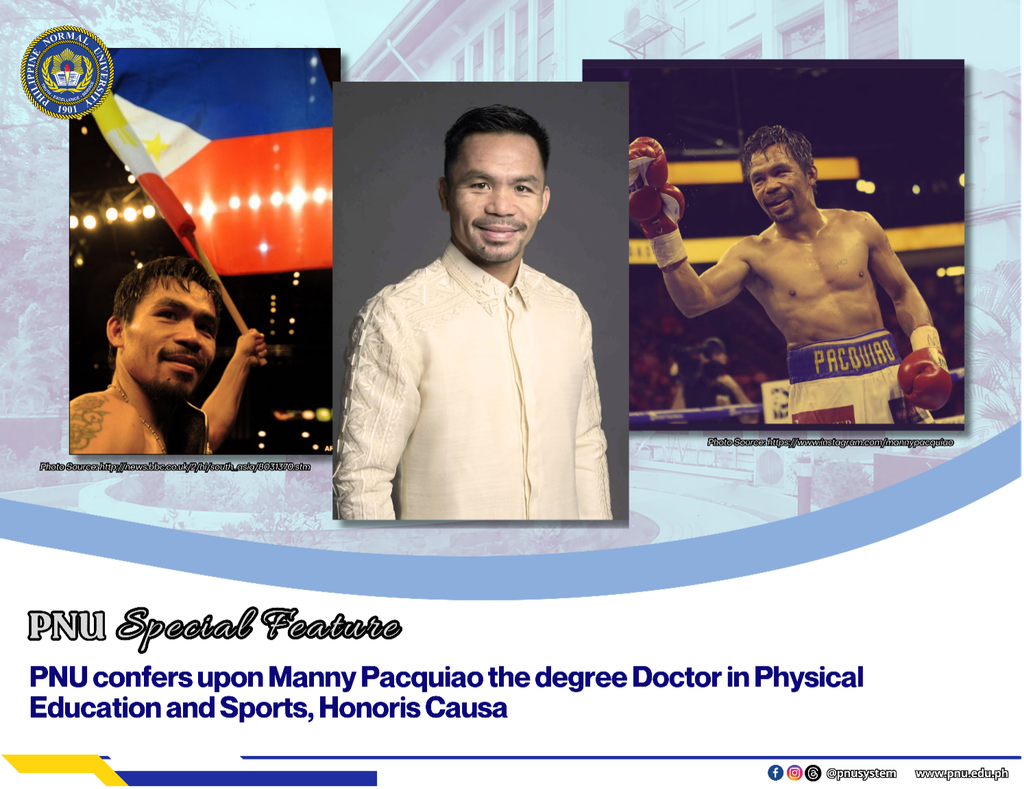
When we think of Philippine sports, perhaps no other name comes as readily to mind as Manny Pacquiao. The “People’s Champ,” the fighting pride of General Santos City, the “PacMan,” and the only fighter in history to ever win world titles in eight different weight divisions, Pacquiao has become more than a champion in the ring. He has become a symbol of Filipino excellence, showing what may be possible when talent is matched by discipline, perseverance, and the determination to rise above one’s circumstances.
For millions of Filipinos, a Pacquiao fight was never simply a sporting event. Televisions were turned up, families and friends gathered around screens, and Filipinos from different walks of life found themselves cheering for the same man. For a few hours, the country seemed united by one shared hope. His fights became moments of collective pride, bringing Filipinos at home and around the world together under one flag and one name.
Yet Pacquiao’s contribution to Philippine sports is bigger than his victories. His greatest legacy lies in what his journey has come to represent: that excellence can emerge from humble beginnings, that circumstances need not dictate one’s destiny, and that sports can become a powerful tool for personal transformation, social mobility, and national pride.
This is the kind of excellence that makes Pacquiao a fitting recipient of the Doctor in Physical Education (PE) and Sports, Honoris Causa, from the Philippine Normal University, the country’s National Center for Teacher Education.
Born on December 17, 1978, Emmanuel “Manny” D. Pacquiao grew up in abject poverty in General Santos City. At a young age, boxing offered him more than an outlet for his talent. It offered a prospect. What began as a pursuit shaped by necessity became a lifelong discipline that would take him to the highest levels of international sport.
His story resonates with many Filipinos because it is rooted in realities they know: limited opportunities, economic hardship, and the dreadful task of dreaming beyond one’s situation. But Pacquiao did more than overcome those circumstances. He turned them into fuel.
His rise in the world of boxing is shaped by discipline, grit, courage, and the willingness to improve. These are among the very qualities that physical education and sports seek to cultivate. Beyond physical strength and skill, sports teach individuals to set goals, confront failure, work with others, develop discipline, and discover what they are capable of achieving. Pacquiao’s life became a living testament to these lessons.
His excellence helped elevate Philippine sports on the global stage. At a time when Filipino athletes often competed internationally with limited resources and recognition, Pacquiao became a global figure whose achievements drew the world’s attention to the Philippines. His name became associated not only with boxing, but with the resilience and fighting spirit of the Filipino people.
More importantly, he made young Filipinos see themselves in the possibility of becoming athletes. For aspiring boxers and athletes, Pacquiao became proof that the journey from a modest beginning to the world’s biggest arenas was not beyond reach. His story gave sport a human face and showed how athletic excellence could open doors, change lives, and inspire others to pursue their own potential. But Pacquiao’s contribution does not end with his accomplishments as an athlete.
Beyond the boxing ring, his journey demonstrates how the values cultivated through sports can extend into public life. As a public servant, he has advocated for programs intended to uplift marginalized communities and promote youth development. His initiatives have reflected his belief in the capacity of sports to foster discipline, character, unity, and national pride.
His philanthropy further extends this commitment. Through initiatives supporting education, health, livelihood, and community development, Pacquiao has sought to create opportunities for people who, like him, may have started with very little or none. His work reflects a broader understanding of success: achievement becomes more meaningful when it creates opportunities for others.
Recognizing Pacquiao, therefore, is not simply an acknowledgment of his fame. It is an acknowledgment of the values behind his journey. He reminds us that greatness is not always born in places of privilege. Sometimes, it begins with a young person who has little more than a dream and the determination to pursue it. Sometimes, that dream grows large enough to inspire an entire nation.
His story also reminds us that the value of sports is not confined to medals, trophies, or records. Sports can change the trajectory of a life. It can create opportunities, cultivate character, and bring people together. As an athlete, champion, inspiration, public servant, and philanthropist, Pacquiao’s journey has been shaped by the same qualities that defined him in the ring: discipline, perseverance, courage, and a commitment to excellence.
That is why the conferment of the Doctor in Physical Education and Sports, Honoris Causa, carries significance beyond the recognition of a celebrated boxer. It honors a life that demonstrates what sports can make possible. It honors an athlete who brought global recognition to Philippine sports and gave generations of Filipinos someone to believe in. Above all, it honors a life that illustrates one of the most enduring lessons of physical education and sports: excellence is not simply about becoming the best athlete one can be. It is about becoming the best person one can be, and using that growth to make a difference beyond oneself.
In recognizing Manny Pacquiao, the Philippine Normal University recognizes not simply a champion, but the transformative power of sports itself. In him, PNU finds a fitting embodiment of excellence: a Filipino who rose from humble beginnings, reached the highest heights of his sport, and continues to turn his success into something larger than himself.
The conferment of the honorary degree was endorsed by the PNU Academic Council and the Board of Regents and subsequently approved by the Commission on Higher Education with CEB Resolution No. 625-2026.
The conferment ceremony will take place on Wednesday, September 16, 2026, at 4:00 PM at the PNU Manila Quadrangle.