

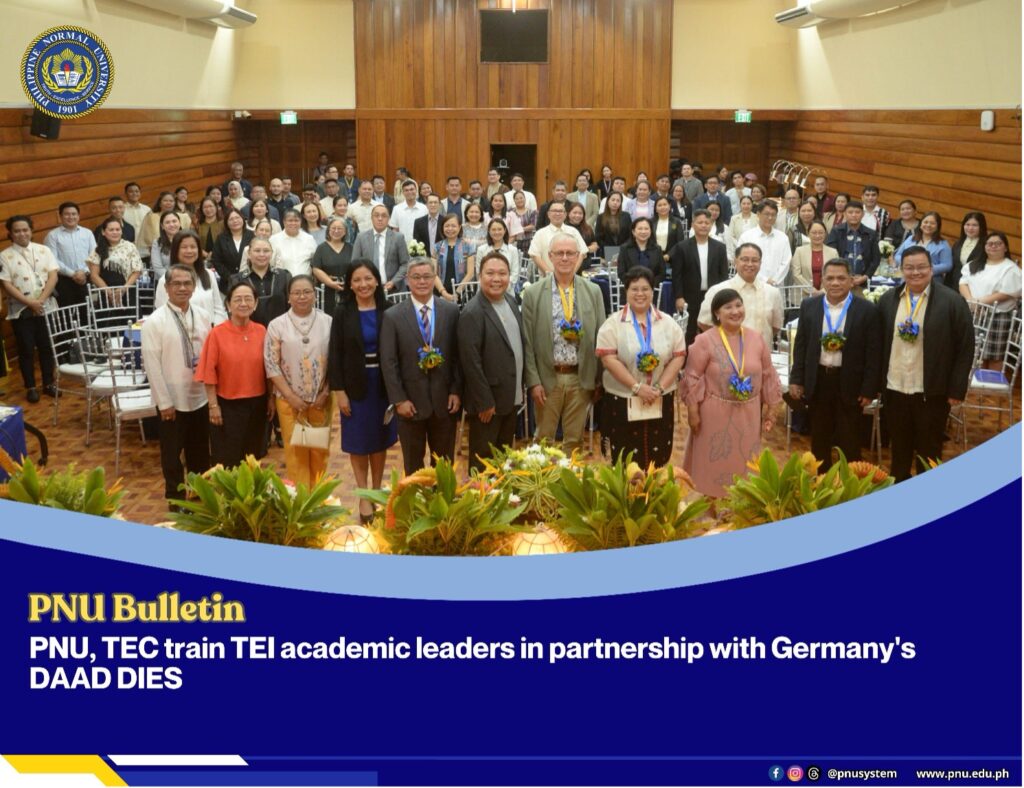
The Leadership Excellence and Development for Teacher Education Institutions (LEAD-TEI) 2026 officially commenced at the Philippine Normal University on June 1, 2026. The executive program brings together future deans, academic leaders, and representatives from teacher education institutions across the country. The program will run in three phases: the initial phase held at PNU, the second phase conducted online, and the final phase to be held in Dumaguete City later this year.
The program is co-organized by PNU, Centro Escolar University (CEU), De La Salle University Manila (DLSU Manila), Negros Occidental State University, Silliman University, University of the Philippines Manila, and the University of the Philippines Los Baños (UPLB). LEAD-TEI 2026 is funded by the Teacher Education Council (TEC) and co-sponsored by the German Academic Exchange Service (DAAD), the German Federal Ministry for Economic Cooperation and Development, and the DAAD-DIES Programme through its Dialogue on Innovative Higher Education Strategies and National Multiplication Strategies initiatives.
In his welcome remarks, PNU President Dr. Bert J. Tuga emphasized the importance of developing academic leaders capable of responding to the changing demands of education. He described LEAD-TEI as a platform for reflection, collaboration, and professional growth among leaders in teacher education.
“LEAD-TEI embodies our continued commitment to build strong academic leaders who are prepared to respond to the evolving demands of education,” said Dr. Tuga. He added that “leadership in teacher education is not merely administration; it is also transformation,” underscoring the role of educational leaders in shaping the culture and quality of teacher education institutions.
The opening program featured messages from representatives of partner organizations and higher education institutions, who highlighted the importance of collaboration, innovation, and leadership development in advancing teacher education.
His Excellency Andreas Michael Pfaffernoschke, the German Ambassador to the Philippines, delivered a recorded message that underscored the robust bilateral cooperation driving this initiative. Teacher Education Council Executive Director Dr. Jennie V. Jocson emphasized that Teacher Education Institutions (TEIs) remain central to preparing future teachers. Dr. Tobias Wolf, Section Head for Development Cooperation, Partnership Programmes, Alumni Projects, and Higher Education Management of DAAD, and Dr. Kai Handel, LEAD-TEI German Expert and current Academic Director of the International Deans’ Course, likewise shared their insights through recorded messages. Wrapping up the first group of speakers was Dr. Peter Mayer, the Former Academic Director of the International Deans’ Course, who provided a quick discussion that served as a precursor to his keynote address.
The program was further enriched by the wisdom of the distinguished leaders at the helm of the partner institutions. CEU President Atty. Danilo L. Concepcion underscored the vital role of teachers in shaping future generations and called for reducing administrative burdens so educators can focus more on teaching and learning. He also stressed the importance of preserving academic freedom within teacher education institutions. Dr. Christine Ballada, Dean of DLSU’s College of Education, delivered the message of DLSU President Brother Bernard Oca FSC, which centered on the importance of such programs. University of the Philippines Los Baños Chancellor Dr. Jose V. Camacho Jr. spoke on leadership that inspires transformation, while University of the Philippines Manila Chancellor Dr. Michael L. Tee encouraged participants to recognize the interconnectedness of institutions and foster environments where collaboration and innovation can thrive toward a shared vision.
LEAD-TEI 2026 Program Leader Dr. Gladys C. Nivera introduced the program, trainers, and participants. She described the initiative as more than a training program, calling it an investment in the quality of teacher education and in the development of future academic leaders.
Following the opening program, participants proceeded to the morning plenary sessions, which focused on current issues and emerging directions in teacher education and higher education governance.
In her keynote address, “Teacher Education in the Philippines: Directions, Challenges and Opportunities,” Dr. Jocson examined the current state of teacher education and identified key issues affecting the sector.
She cited the uneven distribution of teacher education institutions across regions, particularly in Mindanao, the predominance of private TEIs, concerns regarding teacher preparation quality, and the mismatch between teacher education programs and workforce needs. She also pointed to declining literacy and numeracy outcomes among learners, fragmentation among education agencies, and the movement of licensed teachers to careers outside the teaching profession. Despite these challenges, Dr. Jocson highlighted opportunities for strengthening teacher education through initiatives led by the Teacher Education Council. These include programs supporting the upskilling and reskilling of educators, recognition and incentive programs for exemplary teaching practices, research-oriented initiatives, and career-stage frameworks that support continuous professional growth.
The final keynote session was delivered by Dr. Peter Mayer, who discussed “Higher Education Systems and Governance: Changes and Perspectives.” He described governance as the institutional arrangements, rules, procedures, norms, and values that define how decisions are made, how stakeholders interact, and how accountability is maintained within higher education systems.
Dr. Mayer highlighted the roles of governments, academic communities, and external stakeholders in shaping university governance. He explained how governance structures influence institutional direction, academic programs, and leadership practices, while emphasizing the evolving responsibilities of academic leaders in increasingly complex higher education environments.
On the afternoon of the first day, participants were divided into two breakout groups to experience more diverse interactions as they delved into the assigned tasks of the program.
As LEAD-TEI 2026 progresses through its subsequent phases, it promises to equip these academic leaders with the strategic foresight and collaborative networks necessary to drive sustainable, transformative reforms in Philippine teacher education.
Article written by Princess Denisse Dane B. Aduca of the PNU Manila Creative Team
***