
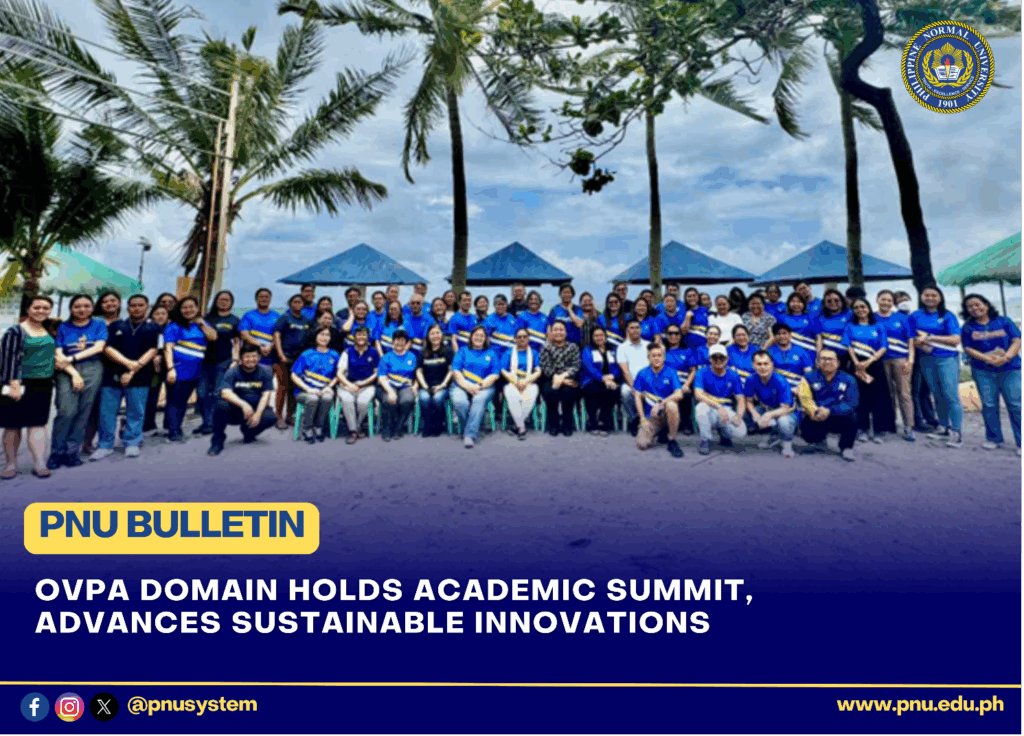
The Office of the Vice President for Academics, under the leadership of Vice President Dr. Marilyn U. Balagtas, organized the Academic Summit from June 3 to 5, 2025 at the Waterfront Beach Resort in Morong, Bataan.
The summit opened with Dr. Marilyn U. Balagtas, Vice President for Academics, who explained that the 2025 Academic Summit aims to bring together university officials, leaders, and experts to collaboratively shape the directions, priorities, and strategies for advancing impactful and sustainable academic innovations starting in the Academic Year 2025-2026. She emphasized the importance of consolidating innovative plans across VP domains and campuses to support the entire PNU System’s academic programs. Dr. Balagtas highlighted the need to design programs and projects that respond to the evolving demands of teacher education in the Philippines, with a focus on system-wide implementation, monitoring, and evaluation. She also stressed the need to harmonize academic efforts throughout PNU to boost effectiveness, efficiency, and impact.
Discussions began with presentations from Dir. Brando Palomar of the RITQ on the reframing of the teacher education curriculum. The new structure reduces ProfEd courses, incorporates a year-long internship, and clusters focusing on key aspects of teaching and learning. He also explained that the next phase of review targets specialization courses and inclusive education contexts.
Support units under the Office of the Vice President for Research, Extension, Planning, and Quality Assurance (OVPREQA), led by Dr. Teresita Rungduin, also shared their aligned efforts in support of the Academic Programs. Dir. Ruel Avila of QAMO discussed certification and accreditation updates, while Dir. Marivilla Lydia Aggarao of the KMFSO presented their phased Knowledge Management Roadmap. Dir. Eisha Fernandez of CPEO also shared cross-border curriculum collaborations, including with Timor-Leste, and its role in Bukluran 2025.
Dr. Lordinio Vergara, the Vice President for Finance and Administration, expressed the office’s commitment to supporting the OVPA and its units by enhancing service delivery through the FAST framework. This initiative involves streamlining and accelerating request processing, upgrading infrastructure and automating available resources, and offering skill and capacity-building training. Ms. Nerlyn Makinano from the Budget Unit also discussed the utilization of the allotted budget in 2025 for the OVPA domain.
Dr. Denmark Yonson, the Vice President for Student Success and Stakeholder Services, emphasized the importance of supporting data collection efforts for the QS reapplication process, calling on OVPA units to assist in providing the necessary information. Dir. Merimee Siena reported alarming dropout trends monitored by SASO, highlighting mental health challenges and areas for systemic academic and psychosocial intervention. Dir. Henelsie Mendoza of the Admissions Office shared their framework for revising the PNUAT and redefining applicant classifications. Dir. Bryan Dayuta from the Linkages and Internationalization Office presented an overview of CMO No. 03, s. 2025, concerning international travel requirements, including timelines for submissions and post-travel accomplishment reports. He also discussed the upcoming QS Ratings, highlighting the data needed from various units and noting concerns about the availability and timeframe for compiling data spanning several years. Additionally, Dir. Glenda De Lara of ARSO shared findings from their tracer study covering graduates from 2019 to 2024 (undergraduate) and 2019 to 2023 (graduate), acknowledging challenges such as insufficient funding, staffing, and incomplete records. Dir. James Bailon of EMO provided updates on upcoming university ceremonies, while Dir. Iona Ofelia Zanoria of GEDIO presented strategies for gender and disability inclusivity.
Day 2 began with a presentation by Dr. Leah Amor S. Cortez, the EDP of PNU South Luzon, who focused on student services and inclusion efforts. President Bert J. Tuga also delivered a message commending the campuses for their BLEPT performance and affirming infrastructure upgrades and academic plans that align with national reforms.
Invited speakers examined the implications of laws like RA 11650 and RA 12199 on the teacher education curriculum, discussed by Dr. Melissa Bartolome. Dr. Marilyn Balagtas presented institutional innovations such as DALI, MLTTA, SEMAST, and EPC-TRAIN—models shaped by research and intellectual property considerations.
Additionally, the following drivers of new innovations in the academic programs of the PNU System were discussed: Dr. Felicia Yeban addressed Ladderization in the Undergraduate Programs, Dir. Ruth Alido explained Instructional Design for Flexible Learning, and Dr. Josephine Calamlam and Dr. Gladys Nivera discussed the Mentoring and Coaching Model and the Fiber Model for Professional Development, respectively.
The day concluded with a tribute night honoring retiring faculty members, Dr. Aurora Fulgencio and Dr. Wilma Reyes.
On Day 3, Dr. Agnes Reyes, the EDP of PNU North Luzon, provided the synthesis of Day 2. Afterwards, CMIMO, through Dr. Alido, reported on faculty loads, the validation of instructional materials, and the evolving IM framework. Dr. Palomar’s updates on the revised ProfEd curriculum sparked discussions about graduate program realignment.
Dean Nivera provided a presentation on CTD’s management of 44 graduate programs, addressing the tensions in balancing quality and service, and strategic plans to improve graduate education engagement.
Reports from the following academic units were presented by Dean Antriman V. Orleans for CAS, Dir. Wilfredo Chung for GSRO, and Dr. Joel Tubera for ICEHME. Dean Ilanan and Deputy Dean Voltaire Villanueva of CALL outlined future-ready formal and non-formal learning tracks, including ALS, ODeL, and proposed diploma programs. Dr. Diaz also reported on the approved but still constrained ETEEAP expansion.
Additionally, the following representatives from the campuses shared updates and initiatives that further reinforced the system-wide efforts to harmonize academic planning and operational support across PNU: Dr. Leticia Aquino for PNU North Luzon, Dr. Amor Loniza for PNU South Luzon, Dr. Hazel Andrada for PNU Visayas, and Dr. Rennie Saranza for PNU Mindanao.
Prof. Callo, MISO Director, also presented the status of PNU’s infrastructure, including updates on physical facilities and technological capabilities. In addition, he showcased the software technologies currently available within the university system, emphasizing their role in enabling academic and administrative operations.
Dr. Ralger Jocson closed the summit by emphasizing the value of collaboration in academia and the need to respond to societal demands while upholding educational quality. He affirmed PNU’s role as the leading Teacher Education Institution in the country, calling for program alignment with national standards and continued innovation marked by “Tatak PNU.” He also urged the academic community to guide learners with clarity, confidence, and commitment, grounded in a strong nationalistic perspective. To formally end the program, Dr. Adelyn Abrea, the EDP of PNU Mindanao, delivered the closing remarks.
Throughout the summit, PNU’s commitment to advancing impactful and sustainable academic innovations was evident in its efforts to build a unified, research-informed, and inclusive academic strategy. This approach not only reaffirmed the university’s core mission but also laid a clear foundation for transformative growth and collaboration across the entire PNU system.