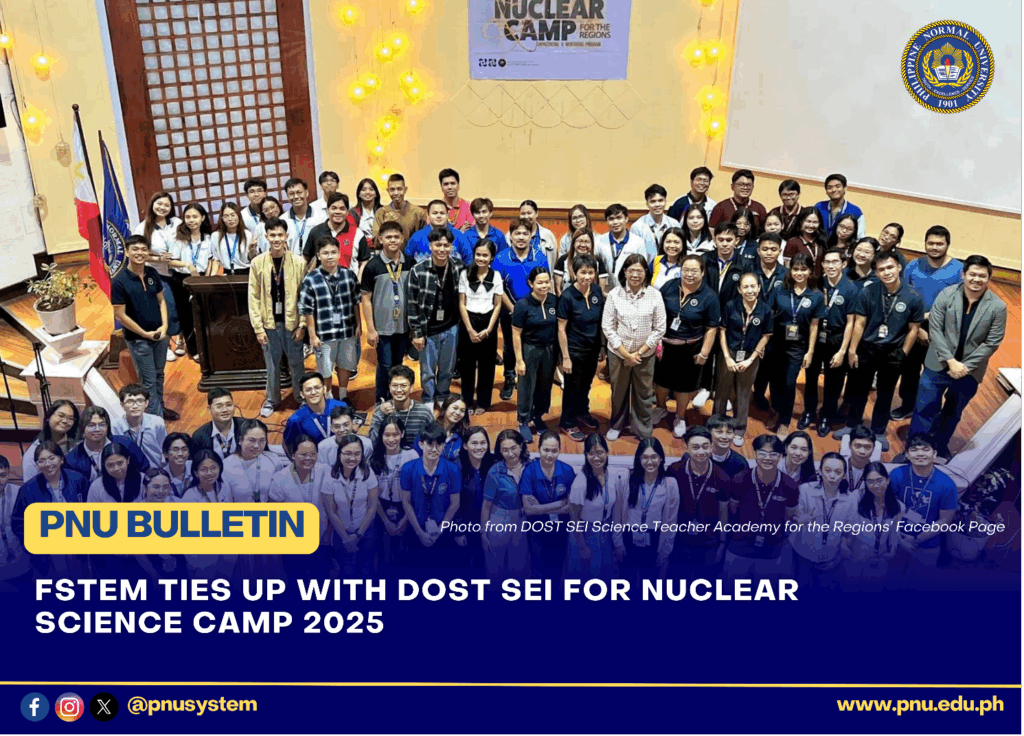
The Nuclear Science CAMP (Capacitating and Mentoring Program) for the Regions officially c
ommenced on April 29, 2025, at the Philippine Normal University (PNU), bringing together pre-service teachers from the Manila, North Luzon, and South Luzon campuses, as well as faculty members, to explore the role of nuclear science in education. The program is a collaboration between the Department of Science and Technology – Science Education Institute (DOST-SEI) and the Faculty of Science, Technology, and Mathematics (FSTeM).
Messages from Dr. Gladys C. Nivera (Dean, College of Teacher Development, PNU), Ms. Cynthia T. Gayya (Chief Science Research Specialist, DOST-SEI), and Ms. April Valdez (Senior Science Research Specialist, DOST-SEI) were delivered during the short opening program prior to the lecture and workshop sessions. These remarks set the tone and underscored the purpose of CAMP.
Day 1 featured foundational sessions on atomic structure, radioactivity, and nuclear energy, with Prof. Vic Marie Camacho and Dr. Alfons Jayson Pelgone discussing fission, fusion, and the life-saving applications of nuclear technology. Dr. Leah Amor Cortez addressed the biological effects of radiation and, together with Prof. Camacho, presented strategies for integrating nuclear science into basic education. These resource persons, who are faculty members of FSTeM, also serve as DOST-SEI STAR trainers.
On Day 2, Dr. Jordan Madrid of the Philippine Nuclear Research Institute (PNRI) highlighted non-power applications of nuclear science in agriculture and industry. Mr. Raymond Sucgang led a hands-on workshop on identifying radioactive materials and utilizing nuclear science for various applications. Mr. Rolando Menor Jr. discussed nuclear power and sustainability, while Prof. Jo-Ann Cordovilla emphasized nuclear safety and risk management. The program concluded with Ms. Valdez sharing personal insights from the Fukushima incident and real-world applications, leaving participants inspired and equipped to integrate nuclear science into their classrooms and communities.
The two-day CAMP concluded with the recognition of speakers and participants, whose active engagement contributed to the success of the event. Through initiatives such as the Nuclear Science CAMP, FSTeM remains committed to advocating for quality STEM education in collaboration with its partners.