

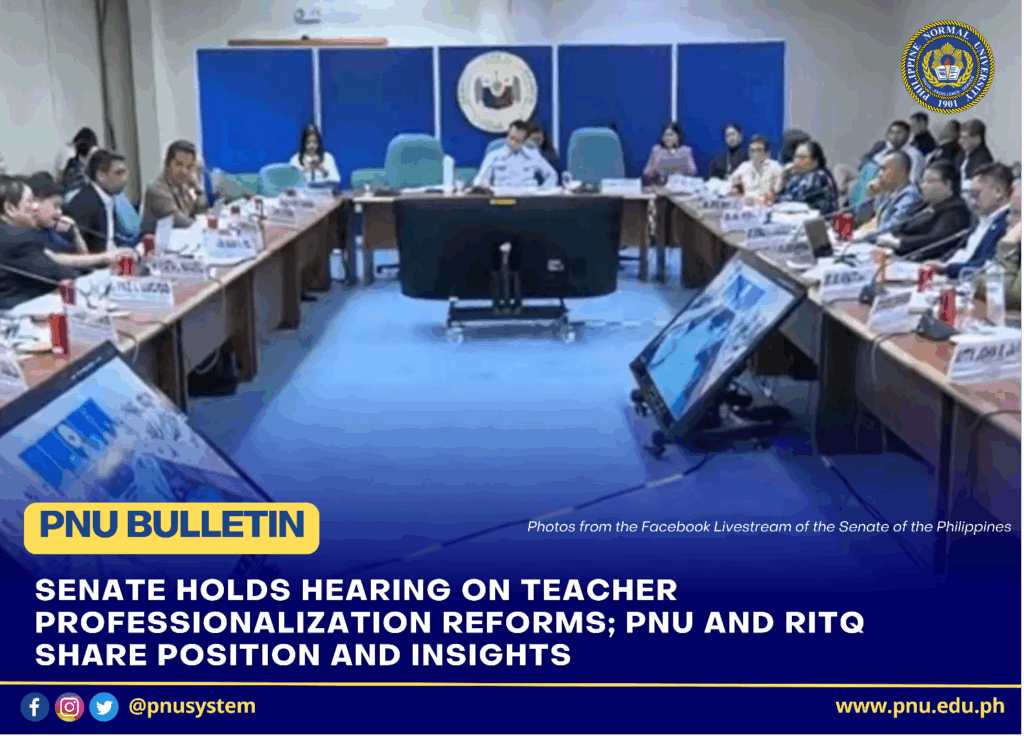
In the pivotal Senate hearing held on January 14, 2025, hosted by the Senate Committee on Civil Service, Government Reorganization, and Professional Regulation, proposed amendments to the Philippine Teachers Professionalization Act (Republic Act No. 7836, as amended by RA 9293) were tackled. To address critical challenges in teacher licensure and professionalization, representatives from various government institutions, educational organizations, and teacher associations were invited as resource persons to share insights on the topic during the hearing. Headlining these institutions were officials from the Philippine Normal University (PNU), the country’s National Center for Teacher Education, and its Research Institute for Teacher Quality (RITQ).
At the helm of the Senate hearing was the Chair of the Senate Basic Education Committee, Senator Sherwin Gatchalian. In one of his statements, Senator Gatchalian underscored the importance of future-proofing the law to continuously respond to the evolving situation in the teaching profession.
Vice President for Academics, Dr. Marilyn Balagtas, presented the university’s position paper, expressing support for reforms to strengthen teacher professionalization in the Philippines. PNU emphasized the importance of broadening the composition of the Board for Professional Teachers by including representatives from diverse educational sectors and addressing regional disparities by engaging stakeholders from Luzon, Visayas, and Mindanao. The university also recommended requiring board members seconded to the Professional Regulation Commission (PRC) to have advanced qualifications, including a doctorate in educational evaluation and extensive teaching experience. On licensure examination reforms, PNU supported releasing component-specific results to provide actionable feedback for teacher education institutions and advocated for establishing an annual testing board with representatives from accredited institutions to ensure rigorous examination processes. PNU also welcomed alternative licensure pathways, such as portfolio assessments, but emphasized the need for a standardized framework for evaluating teaching portfolios aligned with professional teaching standards. Finally, PNU highlighted the importance of transparency in the coverage and results of licensure performance data to foster accountability and improve teacher education programs nationwide.
The RITQ’s position statement, presented by its Director, Dr. Brando Palomar, and Deputy Director, Dr. Maria Teresa Tembrevilla, reinforced PNU’s recommendations. The institute agreed with the provisions in the draft bills, particularly those emphasizing the qualifications of Board members to ensure responsiveness to current and emerging demands in teacher professionalization. RITQ supported the inclusion of alternatives to written examinations, such as portfolio assessments, provided that guidelines are framed according to professional standards and developed by policy-making agencies like the Teacher Education Council (TEC), Commission on Higher Education (CHED), and Professional Regulation Commission (PRC). Additionally, RITQ supported integrating a practical component as a supplement to the written exam, which would evaluate not only content mastery but also the ability to apply pedagogy effectively.
Adding to PNU’s presence and active engagement was its Vice President for Finance and Administration, Dr. Lordinio Vergara, who also represented the Commission on Higher Education (CHED) as part of the Technical Panel for Teacher Education. Dr. Vergara noted that these reforms will benefit the teaching profession and, in the long term, the Philippine education system as a whole.
Through its firm position and practical recommendations for the amendment of the Philippine Teachers Professionalization Act, the university emphasizes its commitment to shaping the future of teachers and their pathways to professionalization in the Philippines. This also conveys the university’s role in driving educational reforms that align with national goals and the evolving needs of the teaching profession.